


By Amelia Pérez
Homemade Lavender Distillation: An Aromatic Journey.
Every summer for years, we have taken advantage of our lavender plants in bloom to distill and obtain essential hydrolat. The process of heat evaporation and subsequent cold condensation using an alembic serves as our R&D, complementing our artisan soap-making activity.
 Homemade distillation serves as our R&D, complementing our artisan soap-making activity.
In our shop-workshop in Santiuste de Pedraza, Segovia, we have planted the lavandula angustifolia variety, which blooms between July and August, lasting approximately one month. This year, we were forced to delay the process a few weeks due to high temperatures, but we couldn't resist taking advantage of a wonderful harvest.
Our intention is to distill the lavender to obtain the hydrolat with essential oil (hydrosol).
A hydrolat (or distillation water or aromatic water) is an aqueous condensation product obtained after the distillation of a natural raw material (lavender), usually plant-based, which remains after steam distillation.
Although used regularly in product descriptions and beauty articles, the word hydrolat is not recognized by the Royal Spanish Academy and derives from the French 'hydrolat'. Floral waters obtained from flowers, such as rose water, are also considered hydrolats.
The process
1. Harvesting
Everything starts at dawn, when the plant is cool and retains a greater concentration of aroma. Hoe in hand, we pull the lavender out with the stem and fill the wheelbarrow. Afterward, we separate the lavender we will use for decoration and make little bundles to hang and dry.


2. Preparing the alembic
Our alembic is 40 liters. It is a small alembic compared to those used in professional essence extraction. To obtain 15ml of lavender essential oil, approximately 1.4 kg of fresh lavender sprigs is required.
The first thing we do is fill the boiler with water. We ensure that the cooling circuit is working correctly. This consists of a condenser, or a copper tank filled with water, which functions to cool the water surrounding the coil that causes the condensation of the steam generated by the boiler. Fresh water is introduced into the bottom of the condenser through a cooling circuit driven by a small water pump, which fills the tank from the bottom and empties it through a pipe at the top that expels the hot water into another container.
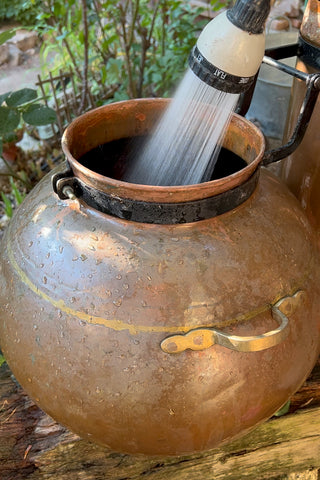

Unlike alcohol distillation stills, those used for essential oil distillation have a tank between the boiler and the dome where the aromatic plants, stems, or leaves to be distilled are placed.
In our case, we fill it with 1.75 kg of flowering lavender stems, cut to make it easier to put them in the tank. Once full, we cover it with the dome and complete the circuit between the dome and the coil with the "swan neck." Everything is ready to light the fire under the boiler.


The last step before starting the distillation is to seal any possible leaks where the steam containing our precious essential hydrolat could escape. To do this, we have about 150g of bread dough prepared, which we apply to the joints of the alembic. As the alembic heats up, the dough expands, sealing any steam leaks.


3. Distillation
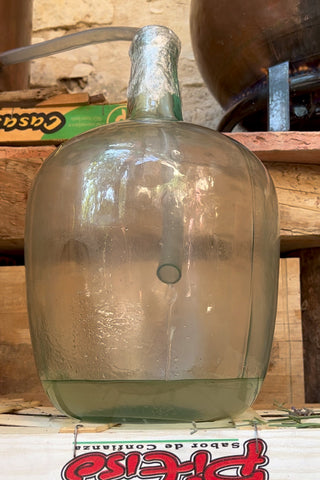
After about 15-20 minutes, a rich lavender aroma begins to be perceived in the air. We watch as our carboy fills, drop by drop, with essential hydrolat. During this process, we can focus our attention on any other activity, provided we check that the condenser water is always cool so that the distillation completes.

4. The hydrolat
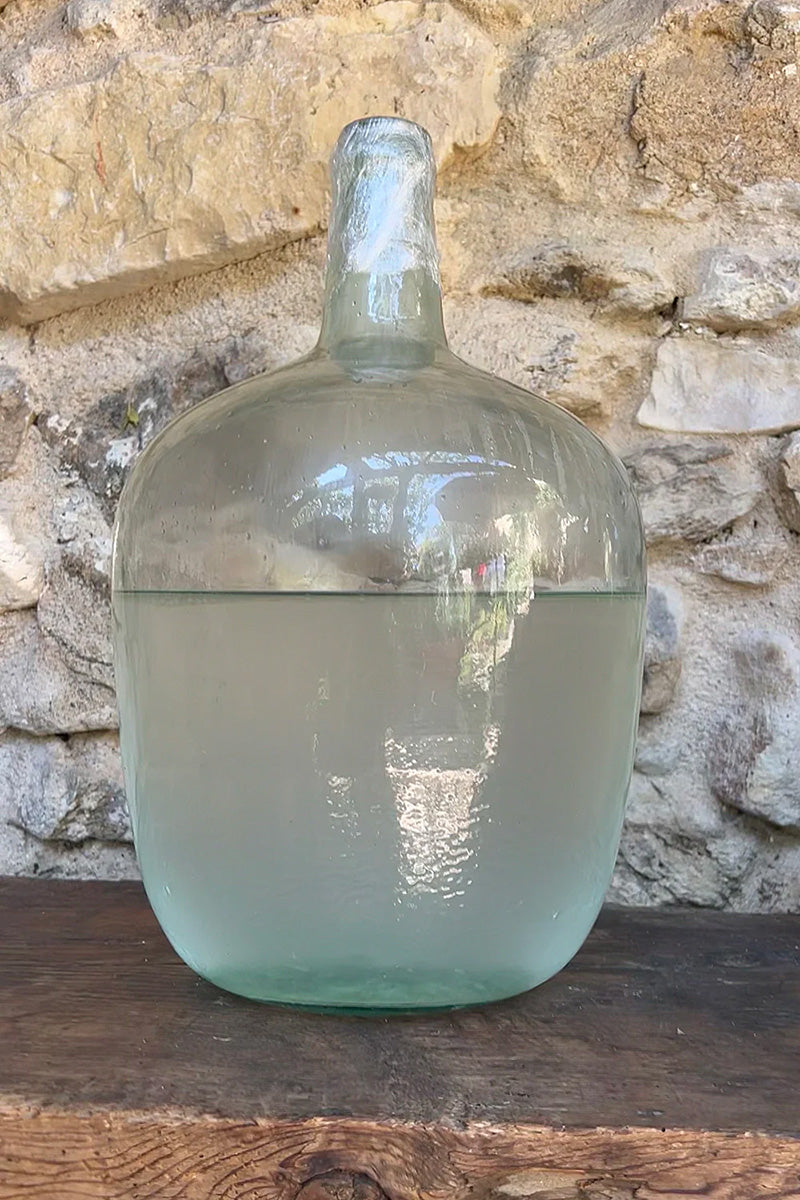
It has taken about two hours since the distillation began to fill our carboy. If we look closely at the surface of the hydrolat, we can see that the top layer, approximately 1mm, is darker; this is the essential oil. Physics takes care of separating the liquids since the density of oil is lower than that of water. This confirms the tremendous amount of lavender needed to extract just a few drops of essential oil.
Lavender hydrolat has calming effects; it is recommended for sensitive and reactive skin, as well as for any skin type after shaving or waxing.
At night, I love to apply the hydrolat to my face with a cotton pad, just like the chamomile infusion I alternate with depending on the day. You can read about the chamomile routine in our article It's time to take care of ourselves.
After quietly and carefully cleansing my entire face, I wash my face with any of the natural soaps recommended below.

Our recommendations
The lavender soap, the carrot soap, the olive and aloe vera soap, the calendula soap, and the rosehip soap are formulated to keep our face clean and luminous. They are very nourishing soaps that we recommend for extremely sensitive and dry skin.
The rosemary soap, the olive and aloe vera soap, the calendula soap, the lavender soap, and the argan soap contain regulating ingredients, which we recommend for oilier skin.


7 comments
Gracias Marisa, es un proceso muy bonito. Me alegra saber de su éxito con la destilación. Que bonito Chubut. Saludos desde España.
Hola. Hermoso articulo. Hoy terminé mi primera cosecha de lavandas, y realice una destilación en un alambique de 50 litros.
Obtuve un rico aceite de 2 kg aprox de ramas. Fueron 40 ml mas o menos. Y tambien el hidrolato. Quedé muy contenta con los resultados.
Soy de Patagonia. Chubut. Argentina
Hola. Hermoso articulo. Hoy terminé mi primera cosecha de lavandas, y realice una destilación en un alambique de 50 litros.
Obtuve un rico aceite de 2 kg aprox de ramas. Fueron 40 ml mas o menos. Y tambien el hidrolato. Quedé muy contenta con los resultados.
Gracias por sus comentarios. Por la zona se pueden comprar los planteles en El Ejidillo, tienen vivero en Valdesimonte, Segovia.
https://www.ejidillo.com
Gracias Amelia, por tan buena explicación tengo una pequeña parcela y la plantaría de Lavanda, sabes donde podría adquirir la simiente, ¿sí es que se reproduce con simiente?
Gracias
Pepe